




Why Outdoor Displays Fail in Sunlight
Outdoor displays often fail for one simple reason – the screen becomes unreadable in sunlight.
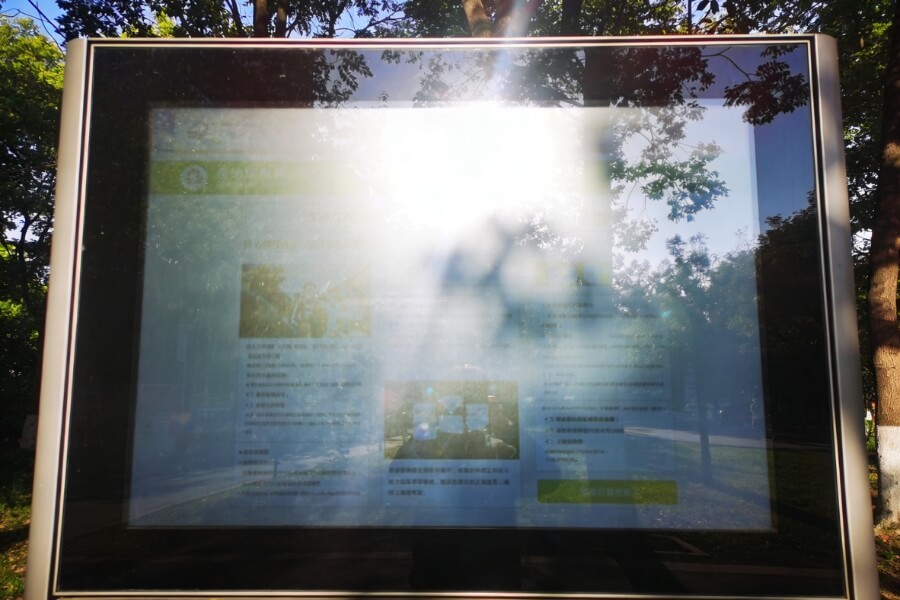
Strong ambient light reflects off the display surface and reduces contrast. As a result, content appears washed out and difficult to read. A standard indoor LCD may look clear in controlled lighting, but outdoors, visibility drops quickly.
This is why sunlight readable displays are designed differently. They focus on managing light, not just producing it.
What Really Determines Sunlight Readability
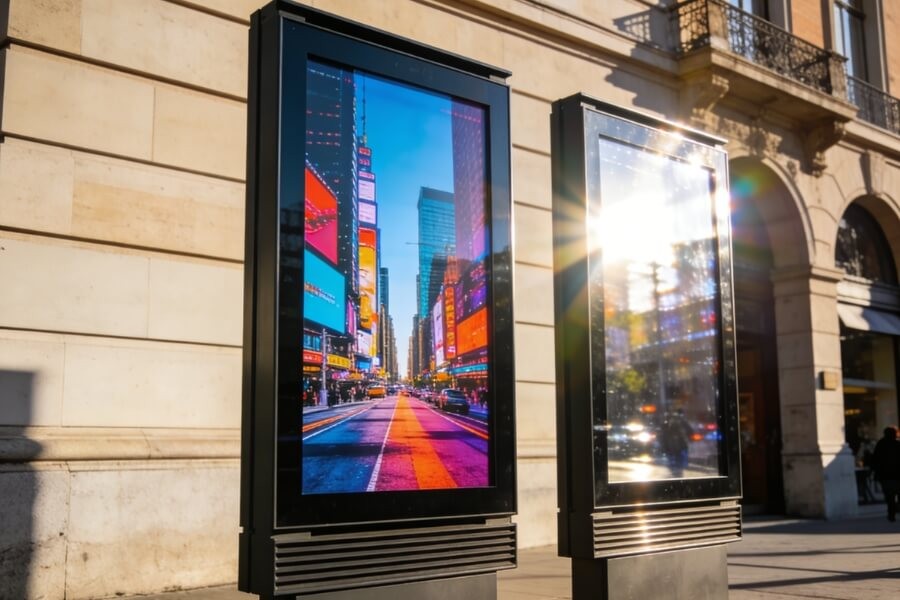
Sunlight readability is not determined by brightness alone.
It depends on three factors working together:
- Brightness – how much light the display emits
- Reflection – how much ambient light is reflected back
- Effective contrast – the visible difference between light and dark areas
Effective Contrast Ratio (ECR) defines real-world readability.
Brightness increases signal strength. Reflection adds optical noise. The balance between them determines whether content remains visible.
Outdoor readability can be simplified into one principle
Higher brightness improves visibility
Lower reflection preserves contrast
Together, they define effective readability
The Key Factors Behind Outdoor LCD Visibility
Brightness – How Displays Compete With Sunlight
Brightness is measured in nits (cd/m²). It determines how well a display competes with ambient light.
Typical ranges:
- 250–450 nits – indoor environments
- 800–1000 nits – entry-level sunlight readable
- 1200–2500 nits – strong outdoor performance
- 3000+ nits – direct sunlight exposure
Higher brightness improves visibility in bright environments. However, it also increases power consumption and heat generation, which must be managed carefully in outdoor systems.
Brightness alone does not ensure readability. Without reflection control, the improvement is limited.
Reflection – Why Screens Wash Out Outdoors
Reflection is the primary reason outdoor displays lose visibility.
Ambient light reflects off the screen and adds brightness to both white and black areas. This reduces the difference between them and lowers contrast.
Typical reflection levels:
- Standard glass – 4–5%
- Air gap structures – up to 8–10%
- Anti-reflective coatings – reduced to 1–2%
Reducing reflection directly improves effective contrast.
In most outdoor scenarios, reducing reflection is more effective than increasing brightness.
Effective Contrast – The Real Measure of Readability
Datasheet contrast ratios are measured in dark environments. They do not represent real outdoor performance.
Effective Contrast Ratio (ECR) accounts for ambient light and reflection.
Typical outdoor ECR levels:
- 2:1 – unreadable
- 5:1 – acceptable
- 10:1 – good readability
- 15–20:1 – excellent clarity
A display rated at 400:1 contrast can drop to around 2:1 outdoors due to reflection.
For outdoor applications, ECR is the only meaningful measure of visibility.
How to Make an LCD Screen Readable in Sunlight
Improving sunlight readability requires two coordinated strategies.
Increase brightness
Higher brightness strengthens the emitted light and improves visibility under strong illumination.
However, increasing brightness alone cannot overcome high reflection. The improvement becomes inefficient at higher levels.
Reduce reflection
Lowering reflection directly improves effective contrast.
Key methods include:
- Anti-reflective (AR) coatings – reduce surface reflection
- Anti-glare (AG) treatments – scatter reflected light
- Optical bonding – eliminate internal reflections
Reducing reflection improves readability more efficiently and with lower energy cost.
Optical Bonding – Why It Matters for Outdoor Displays
Optical bonding removes the air gap between the LCD and the cover glass.
This creates a uniform optical structure and reduces internal reflections.
Key benefits:
- Higher contrast in bright environments
- Improved light transmission
- Sharper image clarity
- Increased resistance to moisture and vibration
In air-bonded designs, multiple interfaces create reflection layers. Optical bonding minimizes these losses and improves overall viewing performance.
For outdoor systems, optical bonding is not optional. It is a core requirement for reliable readability.
Performance Trade-offs You Need to Consider
Improving outdoor readability requires balancing multiple design factors.
- Higher brightness increases heat load and energy consumption
- Additional protective layers can introduce reflection losses
- Optical bonding improves clarity but adds cost
- Glass protection improves durability but reduces light transmission
A well-designed display system optimizes these factors together. Focusing on a single parameter often leads to suboptimal performance.
What Ensures Long-Term Outdoor Performance
Outdoor environments introduce challenges beyond visibility.
Temperature performance
Standard LCD operating range:
- -20°C to +70°C
Outdoor environments often exceed these limits.
Hi-Tni technology extends panel tolerance:
- Up to -40°C to +110°C at the panel level
This prevents freezing at low temperatures and blackening at high temperatures.
Thermal management
High brightness generates heat. Direct sunlight increases surface temperature further.
Effective thermal design includes:
- Active cooling systems
- Heat dissipation structures
- Enclosure ventilation
Maintaining stable internal temperature is critical for long-term reliability.
Environmental protection
Outdoor displays must withstand environmental exposure.
Key requirements:
- IP65 or higher protection rating
- Resistance to dust and moisture
- UV stability for long-term use
These factors ensure consistent operation in public and industrial environments.
LCD vs OLED – Which Works Better Outdoors
OLED delivers high contrast in controlled environments. However, LCD remains more suitable for outdoor applications.
Key differences:
- LCD supports significantly higher brightness levels
- LCD avoids burn-in in static display scenarios
- LCD performs more reliably under UV exposure
- LCD offers better cost efficiency for large installations
For outdoor use, brightness stability and durability are more important than theoretical contrast performance.
Where Sunlight Readable Displays Are Used
Sunlight readable displays are widely used across real-world environments.
- Retail storefronts – maintaining visibility through glass façades
- Transportation systems – bus stops, airports, and rail networks
- Industrial HMI – outdoor control systems and machinery
- Public kiosks – self-service terminals and payment systems
- Smart city infrastructure – real-time information displays
Each scenario requires a tailored balance of brightness, reflection control, and system durability.
How AI Is Changing Outdoor Display Performance
AI enhances how displays adapt to changing environments.
Key applications include:
- Automatic brightness adjustment based on ambient light
- Energy optimization through dynamic dimming
- Predictive maintenance based on system monitoring
AI improves efficiency and operational reliability. However, it does not replace optical design fundamentals.
Display readability still depends on brightness and reflection control.
How to Choose the Right Sunlight Readable Display
Use this checklist when selecting a solution:
- Define the lighting condition – direct sunlight or indirect exposure
- Select brightness based on environment requirements
- Prioritize reflection control – AR coating and optical bonding
- Evaluate thermal design and operating temperature range
- Ensure system durability with appropriate IP rating
Focus on real-world performance rather than datasheet specifications.
Key Takeaways for Outdoor Display Selection
Sunlight readability is not achieved through brightness alone.
It is defined by effective contrast, which depends on both display luminance and reflection control.
A well-designed outdoor LCD balances brightness, minimizes reflection, and maintains stable performance across environmental conditions.
FAQ
Q1:What brightness is required for sunlight readable displays?
Most outdoor applications require at least 800–1000 nits. For direct sunlight exposure, 1200–2500 nits is typically needed to maintain visibility. However, brightness alone is not enough. Reflection control must also be considered to ensure stable readability in real-world conditions.
Q2:Why is reflection control more important than brightness?
Reflection raises the brightness of both light and dark areas on the screen, reducing contrast. Increasing brightness helps, but reducing reflection improves visibility more efficiently. In most outdoor environments, controlling reflection has a greater impact on readability than simply adding more brightness.
Q3:What is optical bonding and why is it used?
Optical bonding removes the air gap between the display and the cover glass. This reduces internal reflections and improves light transmission. It also enhances contrast, clarity, and durability, making it a key technology for outdoor displays operating in bright or harsh environments.
Q4:What temperature range is needed for outdoor LCD displays?
Standard LCDs operate between -20°C and +70°C. Outdoor applications often require extended ranges to handle extreme heat or cold. Proper thermal management, combined with high-temperature panel design, ensures stable performance and prevents issues such as blackening or slow response.
Q5:Is OLED suitable for outdoor displays?
OLED provides high contrast in controlled environments but is less suitable for outdoor use. It has lower peak brightness and is more sensitive to heat and long-term exposure. LCD remains the more reliable choice for outdoor applications where durability and visibility are critical.
RUSINDISPLAY Solution
RUSINDISPLAY focuses on delivering display solutions that perform reliably in real-world environments. For projects that require strong visibility, our high-brightness LCD systems are designed with balanced brightness, controlled reflection, and optimized structural integration to ensure stable readability under complex lighting conditions.
Beyond hardware, RUSINDISPLAY combines display engineering with scene-based design and system integration. From retail storefronts to public information systems, we help clients build display solutions that remain clear, durable, and efficient throughout long-term operation.