




Why Static Window Displays Are Losing Attention
Traditional window displays rely on static visuals. They present products clearly, but they struggle to hold attention in high-traffic environments.
Modern consumers expect movement, interaction, and context. Static content cannot adapt to different audiences or time periods, which limits engagement and reduces conversion opportunities.
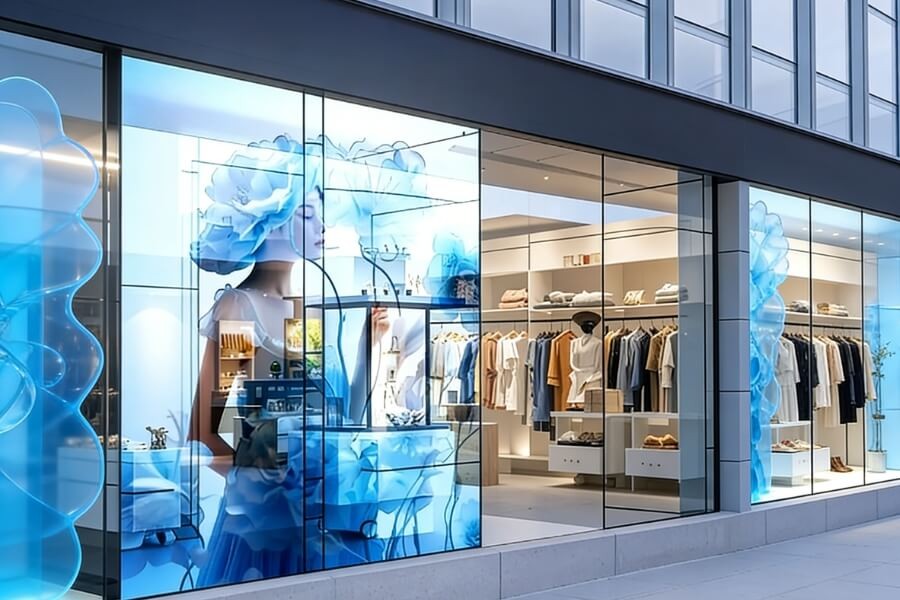
Transparent display technology introduces a new approach. It turns the window into a layered communication surface, where digital content appears directly alongside physical products, reducing the gap between information and decision-making.
Key Elements of an Effective Window Display
A successful window display depends on how well visual structure supports understanding. Technology enhances the result, but clarity drives performance.
Layered storytelling
Content should appear next to the product it explains. This reduces cognitive effort, allowing customers to understand features without entering the store.
Visibility without obstruction
High Transparency maintains natural light and interior visibility. This ensures the display enhances the space rather than blocking it.
Engagement and interaction
Dynamic or responsive content increases dwell time. When a display reacts to presence, it shifts from passive viewing to active engagement.
Best Display Technologies for Window Displays
Different technologies create different visual outcomes. The choice affects brightness, Transparency, and how content interacts with space.
Transparent OLED
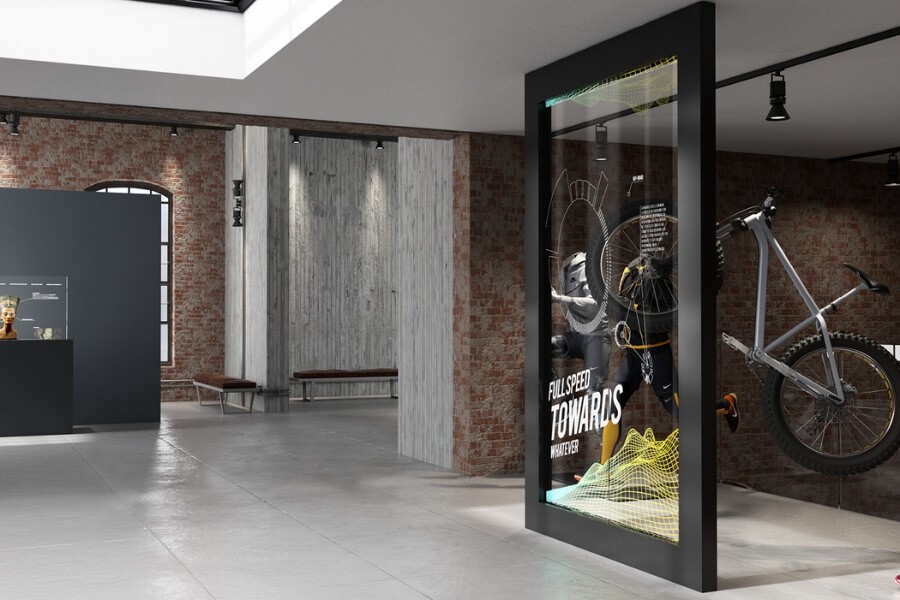
Transparent OLED uses self-emissive pixels on a transparent substrate. Each pixel generates its own light, which removes the need for a backlight and allows inactive areas to remain see-through.
- No backlight – enables true Transparency
- High contrast – improves readability in controlled lighting
- Ultra-thin structure – integrates directly into glass
This structure preserves visibility behind the display while delivering sharp foreground content. However, brightness is limited compared to LED systems, which makes it better suited for indoor or shaded environments.
LCD Video Wall
LCD video walls use a backlight system, which increases brightness but removes Transparency. This makes them effective for full-screen visual dominance.
- High brightness output – maintains visibility in bright interiors
- Large continuous surface – supports video-driven storytelling
- Stable operation – suitable for long running hours
Because LCD panels are opaque, they replace the window visually rather than blending with it. This makes them ideal when the goal is to capture attention rather than maintain spatial openness.
Transparent LED and Film Displays
Transparent LED systems use spaced LED structures to balance brightness and light transmission.
- High brightness – supports direct sunlight conditions
- Adjustable Pixel Pitch – controls Transparency and resolution
- Lightweight structure – suitable for large glass façades
Wider Pixel Pitch increases Transparency but reduces image detail. This trade-off defines how clearly products remain visible behind the screen.
These systems are the most effective choice for outdoor storefronts, where brightness and long-distance visibility are critical.
How to Choose the Right Display for Your Window
Display selection depends on environment, viewing conditions, and communication goals. The wrong choice often leads to poor visibility or reduced impact.
Use Transparent OLED when
- The installation is indoors or shielded from direct sunlight
- Product visibility is essential
- Content is designed to complement physical objects
Use LCD video wall when
- High brightness is required indoors
- The window needs to function as a full digital screen
- Content relies on motion graphics or promotions
Use Transparent LED when
- The storefront faces strong daylight
- Long-distance visibility is required
- The display must balance visibility and advertising
Brightness determines whether content can be seen. Transparency determines whether space remains open. The correct balance depends on the installation environment.
Creative Window Display Ideas for Retail Stores
Technology enables visual effects, but structure defines how information is delivered.
Layered storytelling window
Products remain visible while digital overlays explain features or highlight details. This reduces the need for separate signage and keeps attention focused in one place.
Interactive display window
Sensors detect movement or proximity and trigger content changes. This allows the display to respond to user behavior, increasing engagement and encouraging exploration.
Full-glass digital façade
The entire window becomes a display surface. This approach is effective for large-scale campaigns, where visibility and motion are more important than transparency.
Minimalist transparent display
Content is limited to essential information. This maintains a clean visual structure while supporting product-focused communication.
How AI Makes Window Displays More Interactive
AI enables displays to adapt in real time. Content is no longer fixed but responds to external conditions.
- Audience detection adjusts content based on demographics
- Time-based control aligns messaging with peak traffic periods
- Behavior tracking identifies which content increases engagement
For example, promotional content can be shown during high-traffic hours, while brand storytelling appears during quieter periods. This improves relevance and increases conversion potential.
What to Consider Before Installing a Window Display
Performance depends on how well the system fits the physical environment.
Ambient light
Strong sunlight reduces perceived contrast. High-brightness solutions are required for street-facing windows.
Viewing distance
Pixel Pitch determines clarity. Smaller spacing improves detail but reduces Transparency.
Structural integration
Displays must align with glass structures, mounting systems, and cable routing. Clean integration improves both reliability and appearance.
Maintenance and operation
Long-term performance requires stable power systems, content management, and remote monitoring. Poor system planning often leads to downtime.
Conclusion
Creative window design has shifted from static presentation to dynamic communication. The display is no longer separate from the space but becomes part of it.
Transparent OLED, LCD video walls, and LED film displays each serve different roles. The key is selecting the right technology based on light conditions, viewing distance, and communication goals.
Designing an effective window display requires balancing brightness, Transparency, and installation constraints. Each decision directly affects visibility, engagement, and long-term performance.
RusinDisplay supports these requirements with integrated OLED, Transparent Display, and Indoor LCD solutions, helping brands align display technology with real-world environments.
Our systems combine reliable hardware, flexible installation, and centralized content control to ensure consistent performance across retail and commercial spaces. With support from over 120 global brands and experience in complex display integration, we help businesses create window displays that attract attention and deliver measurable results.
FAQ
Q1: What is a transparent OLED display?
A transparent OLED display uses self-emissive pixels on a clear substrate, allowing content to appear while maintaining visibility behind the screen. Because it does not require a backlight, inactive areas remain see-through, enabling digital visuals to align directly with physical objects for layered, context-based communication in retail and exhibition environments.
Q2: Is transparent display suitable for outdoor windows?
Transparent OLED performs best in indoor or shaded environments where contrast can be maintained. In outdoor storefronts with strong sunlight, higher-brightness solutions such as Transparent LED are more effective. They provide better visibility under daylight while still preserving a level of transparency for product display behind the screen.
Q3: What is needed for an interactive window display?
An interactive window display typically includes a display panel, sensing devices such as cameras or motion sensors, a media player, and custom content. These components work together to detect user presence or actions, triggering real-time content changes that improve engagement and guide customer attention toward specific products.
Q4: Will transparent displays affect indoor lighting?
Transparent displays are designed to maintain light transmission when not actively displaying content. High Transparency allows natural light to pass through, preserving interior brightness and openness. Compared to traditional opaque screens, they support a more comfortable indoor environment while still enabling digital communication on the same surface.
Q5: How do I choose between OLED, LCD, and LED solutions?
The choice depends on lighting conditions and display goals. Transparent OLED is suited for indoor, high-contrast storytelling. LCD works for bright, full-screen content where transparency is not required. Transparent LED is the best option for outdoor environments, where strong brightness and long-distance visibility are critical for effective communication.